Showing posts with label elementary art education. Show all posts

Friday, November 2, 2012

Architecture for 4th Grade


I found this wonderful spooky house lesson on smArt blog and adapted it to our lesson on architecture. We briefly discussed Frank Lloyd Wright, some renaissance churches, local buildings, including the school, and asked the question if the design of the building made us want to enter? Did it tell a story? Could you get a feel of what was going to happen inside from the outside? What kind of emotion does this "art we walk through" convey?
It began with what fared to be the most challenging part of the lesson--measuring and the spatial challenge of folding the cut paper in the correct directions. ART IS EVERYWHERE...and it helped us learn these fundamental mathematical skills, Art Works!


The photos to the right show the mathematical part of the lesson--measuring and the spatial challenge of trying to figure out the proper folds to make the "step" pattern and cutting in an inch and half way up our folded paper gave us some needed practice in precision and measuring with a ruler.

It was time to add the architectural features. We mostly focused on the pitch of a roof and its purpose and the frame and pane of a window. Many of the students added landscape architectural features to complete the feel of their homes. Some were spooky, some from the desert, and some made just for dogs.


Friday, September 28, 2012

Art at Home | Art in the World

There are many great resources out there to bring art from the classroom, to home, to the world. This post will share a few different links to a variety of topics; contests, art shows, science, and culture.
Brainstorm about what culture is. You will notice most of the 4th graders related culture to their ethnic heritage. However, many did not know what was unique about their ethnic heritages. 
We have begun a very exciting project for our K-12th graders; a collaborative art show with many artists including our very own art educator, advocate, artist, Tia Flores and the internationally known arts writer and activist, Lucy Lippard. The project, Mixed Blessings Symposium, focuses on culture and our environment. Some of our students will be presenting their art work in this show. Our students have been contemplating their cultures and sharing the unique differences and similarities of each of them.

As a home extension, here is a link to a PBS lesson from the children's show, Maya and Miguel, that encourages celebrating one's culture with family. The lesson is from episode #114, Family Time.  Create a "cultural collection" with all your family members.
More information on Mixed Blessings will be blogged at a later date.

ART CONTEST
Ms. Braik's Geology Club is participating in a wonderful art extention sponsored by AGI, "Imagine Me, An Earth Scientist". It's open to anyone, so even if your child is not in Geology Club, visit the site for contest entry form. Submissions must be postmarked by October 19th.

Art and Neuroscience
CNN recently published a great article, "What the Brain Draws From: Art and Neuroscience" which discusses the tricks that artists have developed for centuries to fool our perception and the importance of color.

Thursday, September 13, 2012

Color Wheel - elementary art class

This week we are introducing the color wheel to the primary grades. I found this uncomplicated color wheel on Art Projects for Kids --if you are interested in printing one for home, it's a free download.
The kinders and first graders will  practice drawing and cutting circles to make their own color wheel. Once completed, we will label the colors and begin our discussion of the senses to prepare for next week's lesson using fruit, the senses, and the color wheel.
Shared on smArt Class

The upper grades have already been introduced to the color wheel in years past, therefore, we will be applying our knowledge in a discussion of our artist of the month,  Vincent Van Gogh (1853-1890). By analyzing his CafĂ© Terrace on the Place du Forum, Arles, 1888, the students should be able to recognize the energizing power of color placement. In this painting, Van Gogh uses the complementary colors (opposite on the color wheel) orange and blue to direct our eye around the image while giving a "glowing" effect from the night windows. When two colors are placed next to one another simultaneous contrast occurs. Simultaneous contrast occurs when any two colors are placed side-by-side. The edge where the two colors meet will change our perception of that color. Impressionist artists used this technique in their works. Van Gogh, a post-impressionist,  uses simultaneous contrast in its most bold form--placing complementary colors next to one another. By doing so, Van Gogh's paintings have a vibrational quality to the colors. The windows glow by placing a blue color immediately next to them. The cobblestones add movement from the repetition, pattern, and color choice. By using the opposite warm and cool colors, it adds depth because cool colors recede into the background and warm colors come forward.

This discussion will help our students choose colors for their CULTURE & IDENTITY piece coming up.

Analyze Van Gogh's The Night Cafe in the Place Lamartine in Arles, September of 1888 with your child.

Look around the house. What items can your child find that represent complementary colors?

Wednesday, September 12, 2012

The Art Mural Needs A Title!

UNTITLED
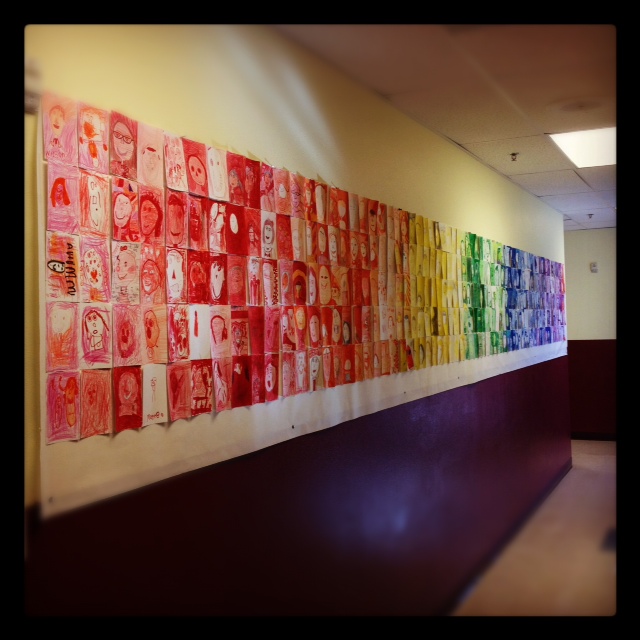
The mural is up and almost complete. As an extension to our mural project, we are holding a friendly challenge to title our piece and to estimate the dimensions of our mural. The students are also reflecting on their role in this public art work and acting as curators by writing  information to accompany our piece.
We have also been discussing the proper etiquette when visiting a gallery or museum space; no touching the art and minimal, quiet whispering so that everyone in the gallery space can absorb and enjoy the art.
Some possible titles thus far from the 3rd and 4th grades:
The Mural of Freedom – Alex M.
World Peace – Priscilla G.
Light of the Rainbow – Willow M.
Inspiration – Alex C.
The Beautiful Universe – ?
Rare Colors – Yuvraj S.
The Kid Rainbow – Abigail B.
The Magic of Art – Nick Z.
Everyone is Different Rainbow - ???
The Rainbow Faces - Genevieve
The Rainbow of All – Laura
The Rainbow of Art – Ana S.
The Hall of Art – Gerardo M.
The Peace of Art School -???
Colorful Culture - Evan
The Coral Rainbow - Emre
The Rainbow of Personalities - Ryan S.
The Personality Rainbow - Mackenzie
We Are the Artists - Mary P.
Differences - Connor
We Are the People - ???
Colors of our Culture - Alyssa F.
The Watcher Wall - Jadera L.
All Cultures Count - Kaya S.
Colorful Mirror - Grace
Rainbow of Friends - Reese W.
Colors of the World - Dani G.
Dream Rainbow - Mohammed
Coloring Cultures - Bella Fillipone
One School, Many Cultures - Samantha H.
One World, Many Cultures - Samantha H.
Cultural Creation - Lina
The Creativity Rainbow - Jammie V.
All of Us - Juliana T.
La Color - Sonja
And the most popular name entered....The Culture Rainbow.
Bravo, Coral Kids for creating such a spectacular art piece for everyone who visits the school to enjoy!

What is your favorite title? Leave comments below for our aspiring artists.

Thursday, September 6, 2012

First Art Project

To kick start the new school year, we focused on a school-wide art project inspired by smART class that would include every student at Coral Academy of Science Elementary School.
The rainbow palette was used to celebrate the many cultures at our school and each child's self-portrait depicts his/her unique role within this one "rainbow".
The classroom was organized with each table as a color on the rainbow and those seated at that table could only use one color to create their self-portraits (monochomatic and exploring value--"How do I color my skin if I only have blue colors?"). The 4th grade was further challenged with adding one analogous ( a "neighbor" on the color wheel) color to their portraits.
For this assignment, I gave very little instruction on how to draw as I wanted to assess the students technique and current abilities. However, I did give them parameters to work within:
1) Self-portrait of head/bust only (one class included bodies for variety)
2) No white space allowed in the foreground or the background
3) Use all three media (artistic tools) in the basket: crayons, markers, and colored pencils.
4) Use the pencil correctly, using very light layout lines and avoiding the use of an eraser.
Art and Literacy
Those who completed their projects early were encouraged to read the selection of art books in the room. A couple of favorites so far were:
Harold and the Purple Crayon by Crockett Johnson
I am Marc Chagall by Bimba Landmann
Be sure to come into the school at the end of next week to see the amazing mural on exhibit on the office gallery wall.

Art and Spatial Reasoning
Observation is key in a fine art curriculum. Consider this particular assignment. Are the eyes on the forehead or has the student observed they lay farther down on the face? Are the eyes spaced too close together? How is the mouth really shaped instead of a simple arch? As the students become better observers of their world, they will  become better artists, readers, scientists, mathematicians, and skilled problem solvers in general.  

Art and Fine Motor Skills
Art is one of the best activities for improving fine motor skills and manual dexterity. Improved motor skills equals improved handwriting (communication) and overall feeling of accomplishment. Many of the activities will focus on improving their motor skills with the art tools and following step-by-step instructions.
Art Fun at Home for Primary Students + Kindergarten
  • Tracing or dot-to-dot
  • Choose pictures with small areas to color.
  • Use different sized crayons, colored pencils or even fine-tip markers to color neatly in the lines.
  • Play-doh sculptures
  • Beading jewelry 
Kindergarten Focus:
This week kindergarten focused on creating faces using shapes: ovals, circles, triangles, etc. They learned what a background was in a picture.


Wednesday, August 22, 2012

Welcome Back from Art at Coral Elementary!


The 2012-2013 school year has begun and it 's time for my K-4th Art Smart students to start creating.

Before we get into lessons, I would like to introduce myself. My name is Skye Snyder and this is my tenth year teaching and my first year at Coral Academy of Science Elementary School here in Reno, Nevada. I am thrilled to bring my education and art background to an alternative school. At Coral, all the students, Kindergarten through 4th grade participate in a fine art curriculum. The students will be learning the art elements and principles of design in a nurturing yet challenging environment. It is my goal to guide our students to become keen observerers of their world and encourage them to visually express their ideas and creativity while learning skills and artistic techiniques. 

I hold a Masters degree in Education and a Bachelors in Art and Anthropology. Additionally, I am a working artist creating photographic portraiture for over twenty years. I invite you to view my online photography presence at Skye Snyder Photography or on Facebook.
As a reminder, this blog's purpose is for sharing information and showcasing our proud students' work to a larger audience. No photographs or names will be used on this blog without written parent/guardian consent. All comments will be moderated by me and I ask everyone to be supportive and encouraging when leaving comments for our little artists. Thank you.

If you are a parent and wanting to communicate, please come by the classroom to talk in the morning at 8am or email me at ssnyder@coralacademy.org.

I am looking forward to experiencing your child's creativity.